


How women in leadership training helped Rani to become an inclusive leader
To mark DEI week, we are sharing Rani’s journey as a testament to the transformative power of Diversity, Equity, and Inclusion in action.
Married at just 16 and a mother soon after, Rani could have easily followed the path many young girls in her community face – early responsibilities and limited opportunities. Yet she refused to let circumstances define her. With determination, she convinced her family to allow her to continue her education, laying the foundation for a future shaped by choice, not constraint.
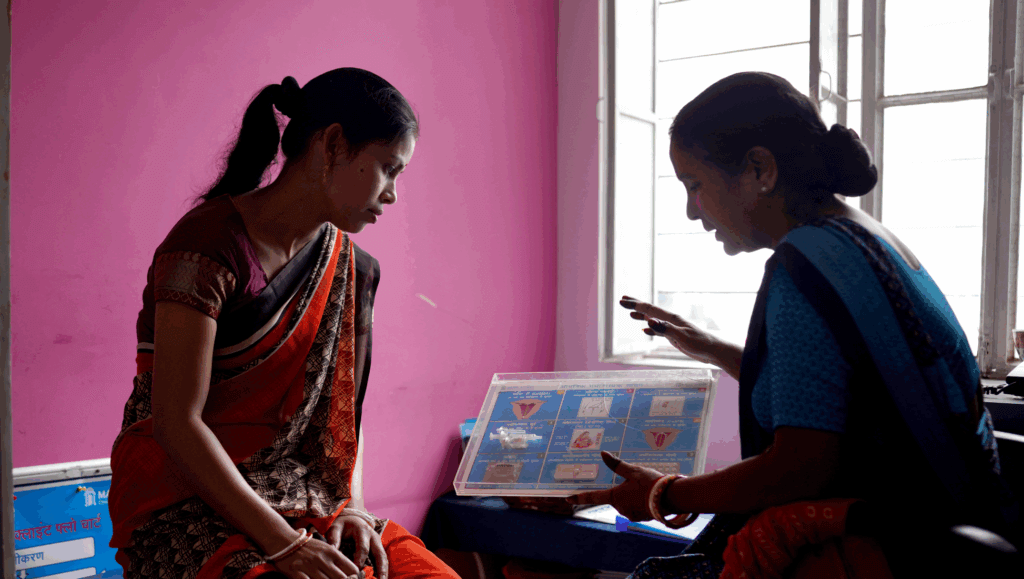
In 2017, Rani joined FRHS India as a counsellor in Bihar. Here, the organisation’s commitment to DEI played a pivotal role in her growth. By providing equal opportunities irrespective of gender, recognising potential, and investing in her development, FRHS India enabled Rani to build her leadership skills. In 2023, she was nominated to attend the Women in Leadership workshop in Hyderabad – one of just 17 women selected from across India. The experience reinforced her confidence, sharpened her skills, and showed her that women from small towns could lead with impact when nurtured in an inclusive environment.
The principles she experienced at FRHS India didn’t stop with her own growth – they shaped how she leads her clients and team. Rani embodies inclusion in every interaction, ensuring that no client is disadvantaged because of background, caste, religion, or disability. Recently, she personally ensured that a client with a physical disability, received female sterilization services at a public facility where FRHS India provides outreach services. Recognizing the barriers the client might face in an inaccessible public facility, Rani guided her with empathy, counselled her on all available family planning options, and ensured she received care safely and respectfully.
Rani’s leadership and the DEI values she internalised also extend to moments of crisis. During an outreach camp in Betul, heavy rains flooded roads and blocked a critical bridge. Instead of giving up, Rani led her team patiently, waiting hours so clients were not left behind. When the waters receded, they successfully provided tubal ligation services to seven women – demonstrating how leadership grounded in DEI can create a tangible impact for communities.


Rani’s story illustrates a powerful ripple effect: MSI’s inclusive culture nurtures leaders, and these leaders, in turn, expand inclusion and equity for the people and communities they serve. Her journey shows that when DEI is not just a principle but a practice, it transforms individuals, organizations, and society.